
 By Callum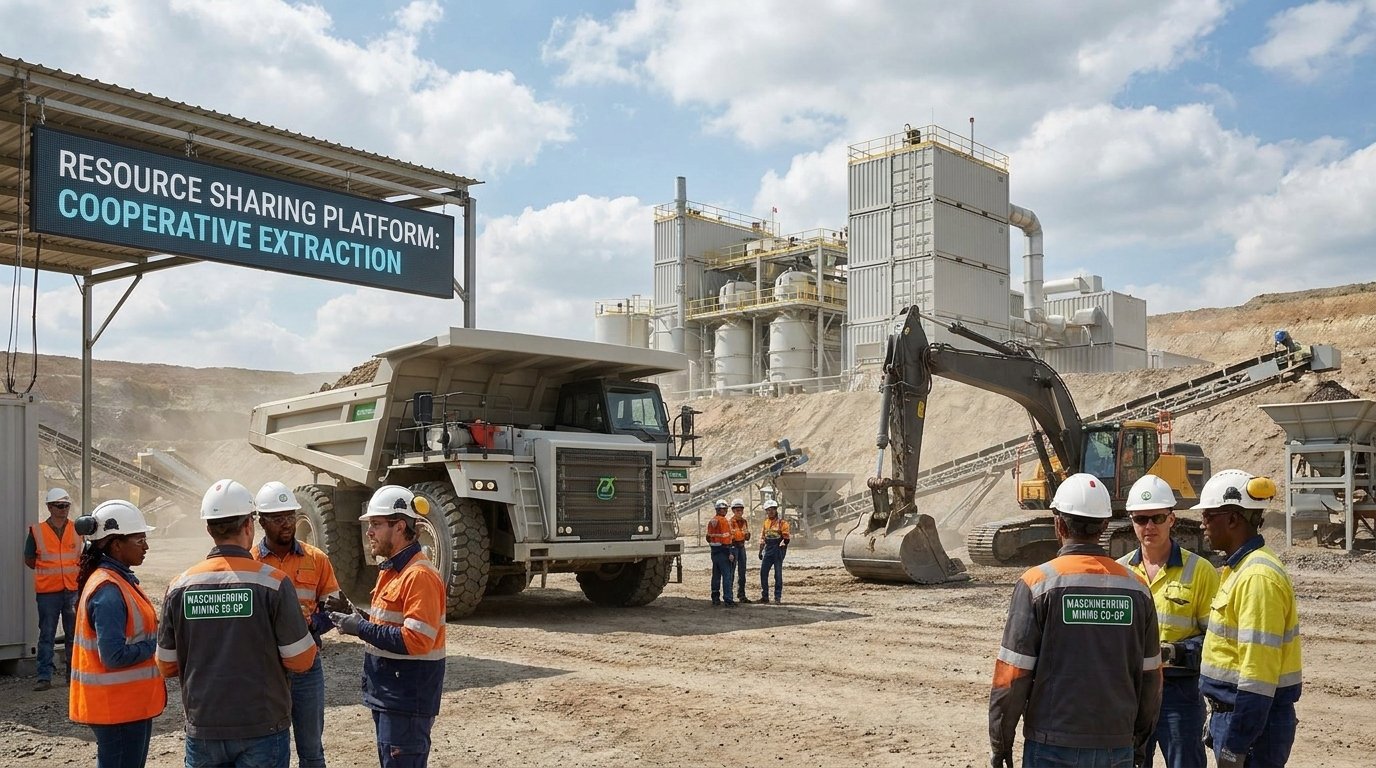
When one hears the word “mining,” the mind typically drifts to images of towering excavators, deep underground shafts, and massive industrial complexes extracting coal, salt, or precious metals. However, in the rural heartlands of Central Europe—particularly in Austria and Germany—a unique and highly efficient form of resource extraction has been quietly flourishing. This model is known as Maschinenring mining.
Contrary to the heavy industrial connotations of the name, Maschinenring mining does not necessarily refer to a specific type of drill or explosive. Instead, it represents a revolutionary organizational structure. The term “Maschinenring” (German for “Machine Ring”) refers to a network of agricultural and forestry contractors. When combined with “mining,” it describes the specialized application of high-efficiency agricultural and forestry machinery for the extraction, haulage, and restoration of mineral resources, as well as the unique provision of heavy machinery for industrial mining operations .
This article explores how the cooperative power of the Maschinenring is changing the landscape of rural mining, quarrying, and forestry logistics.
The Origins: From Farm Cooperation to Industrial Power
To understand Maschinenring mining, one must first understand the Maschinenring itself. Founded in the 1960s as a “bäuerlichen Selbsthilfe” (farmer self-help organization), the Maschinenring was created so that small-scale farmers could share expensive machinery . Instead of every farmer buying a tractor, a harvester, or a plow, they pooled resources through a ring.
This model was wildly successful. Over the decades, these rings evolved from simple tractor-sharing clubs into powerful service providers. Today, organizations like Maschinenring Austria offer services ranging from landscaping and forestry to Personalleasing (personnel leasing) .
It was a logical evolution to move from moving soil for a farm pond to moving overburden for a quarry. As agricultural technology grew more powerful—with tractors exceeding 400 horsepower and forestry equipment capable of handling massive logs. The Maschinenring found itself perfectly positioned to enter the mining and extractive sector. In regions like Braunau am Inn, the Maschinenring has become a staple for land management and heavy civil works, bridging the gap between agriculture and industry .
Specialized Equipment for Steep Terrain
One of the primary niches where Maschinenring mining excels is in “mountain mining” or the management of steep terrain. Traditional mining equipment is often too heavy, too wide, or too cumbersome to operate on the alpine slopes of Salzburg, Tyrol, or Styria.
Here, the Maschinenring leverages specialized “Bergmaschinen” (mountain machines). Contractors like Rupert Berger, a partner with the Maschinenring Salzburg, have demonstrated that utilizing steep-slope machinery like “Mulis” (multi-purpose utility vehicles) and “Mähtraces” (steep-slope mowers) is essential not just for hay, but for accessing mineral deposits and maintaining infrastructure in high-alpine zones .
In the context of mining, these machines are used for:
Maintenance of access roads to high-altitude mines.
Drainage and erosion control on slag heaps and tailings dams.
Vegetation management to prevent landslides over mining claims.
By using the Maschinenring’s network, mining companies do not need to own a fleet of expensive alpine vehicles that they only use three months a year. They simply hire them through the ring, ensuring that specialized machinery is “ausgelastet” (fully utilized) year-round .
Read: Construction Projects
Forestry: The Biological Mine
Forestry is arguably the most critical intersection for Maschinenring mining. While not “mining” in the geological sense, forestry is often categorized under the extractive industries—the “harvesting” of biological assets. However, Maschinenring mining also refers to the extraction of mineral resources found under forested land.
Before a single ton of gravel, limestone, or ore is extracted, the land must be cleared of timber. This is a high-stakes operation combining the speed of logging with the precision of mining.
The Maschinenring is a market leader in “Holzschlägerung” (timber felling) and “Bringung” (transport). Using state-of-the-art Harvesters and Forwarders, they clear mining sites with an emphasis on “bodenschonend” (soil-protecting) techniques . For mining companies, the value proposition is clear: the Maschinenring manages the entire biomass cycle.
Clearing: Harvesting merchantable timber to recoup costs before digging starts.
Biomass: Chipping slash and waste wood to be sold as bioenergy to power the mining operation.
Reclamation: Using forestry expertise to replant native species once the mine reaches the end of its life .
In the Bolzano district of Italy, the Maschinenring model has been specifically funded by the EAFRD (European Agricultural Fund for Rural Development) to support these exact “relief services,” proving that the synergy between logging and quarrying is a strategic asset for the European economy .
Heavy Equipment and Personnel Leasing
Not all Maschinenring mining happens on the surface. The rings have also become a central hub for heavy equipment rental. Through platforms like the Maschinenring Voitsberg, mining operators can source heavy excavators, dump trucks, and specialized drilling rigs . The Voitsberg location, situated at Tagbaustraße 3 in Rosental an der Kainach, operates as a classic “Maschinenring” for heavy industry, renting out Bergbaumaschinen (mining machines) and offering full repair and maintenance services .
However, the most valuable resource provided by the Maschinenring is often not steel, but manpower. The “Personalleasing” (personnel leasing) arm of the Maschinenring provides a flexible workforce to mining operations . During harvest season, a worker might be a farmer. During the winter, that same certified heavy machine operator might work for a salt mine or a quarry.
This “sharing economy” approach to labor allows miners to scale their workforce up and down with commodity prices without the administrative burden of firing or hiring directly.
Environmental Stewardship and Reclamation
Perhaps the most compelling aspect of Maschinenring mining is its inherent focus on “Kreislaufwirtschaft” (circular economy). Because the Maschinenring is rooted in agriculture and environmental stewardship, their approach to mining is holistic. They are not just extractors; they are land restorers.
The service portfolio of any major Maschinenring includes:
Rekultivierung (Recultivation): Restoring topsoil and biological activity to mined land .
Landschaftsbau (Landscaping): Shaping mine dumps to look like natural hills .
Gewässerpflege (Water body maintenance): Cleaning sediment from mining runoff ponds .
For a mining company, hiring a Maschinenring contractor for the reclamation phase is often easier than hiring a pure agricultural firm. The Maschinenring already understands heavy machinery, rock breaking, and slope stabilization. They speak the language of both the bulldozer operator and the organic farmer.
The Future of the Sector
The demand for Maschinenring mining is expected to grow as raw material extraction faces stricter environmental regulations. In Germany and Austria, firms like Agrokomm Maschinenring GmbH and Maschinenring Rotthalmünster GmbH are legally chartered to handle everything from “Verkehrssicherung” (traffic safety) to the “Verwertung von Rohstoffen” (recycling of raw materials) .
As the mining industry pivots toward Electric Vehicles (EVs), the need for domestic sources of lithium, graphite, and rare earth elements is rising. The small-to-medium scale mines of the future will likely look less like the open pits of the past and more like highly managed agricultural projects. The Maschinenring, with its decentralized network of owners, low overhead, and high technical skill, is the perfect vehicle for this transition.
Conclusion
Maschinenring mining is a testament to the power of cooperation. By applying the cooperative “Machine Ring” model to the extractive industries, farmers, foresters, and miners have found a way to reduce costs, increase equipment utilization, and ensure that when the minerals are gone, the land is returned to a productive, natural state.
Whether it is a “Muli” navigating a 50-degree slope in Salzburg to maintain a mine road. A Harvester clearing timber for a new quarry in Braunau, or a Harvester driving profits in Voitsberg. The Maschinenring has proven that mining is not just about taking—it is about managing .