
 By Callum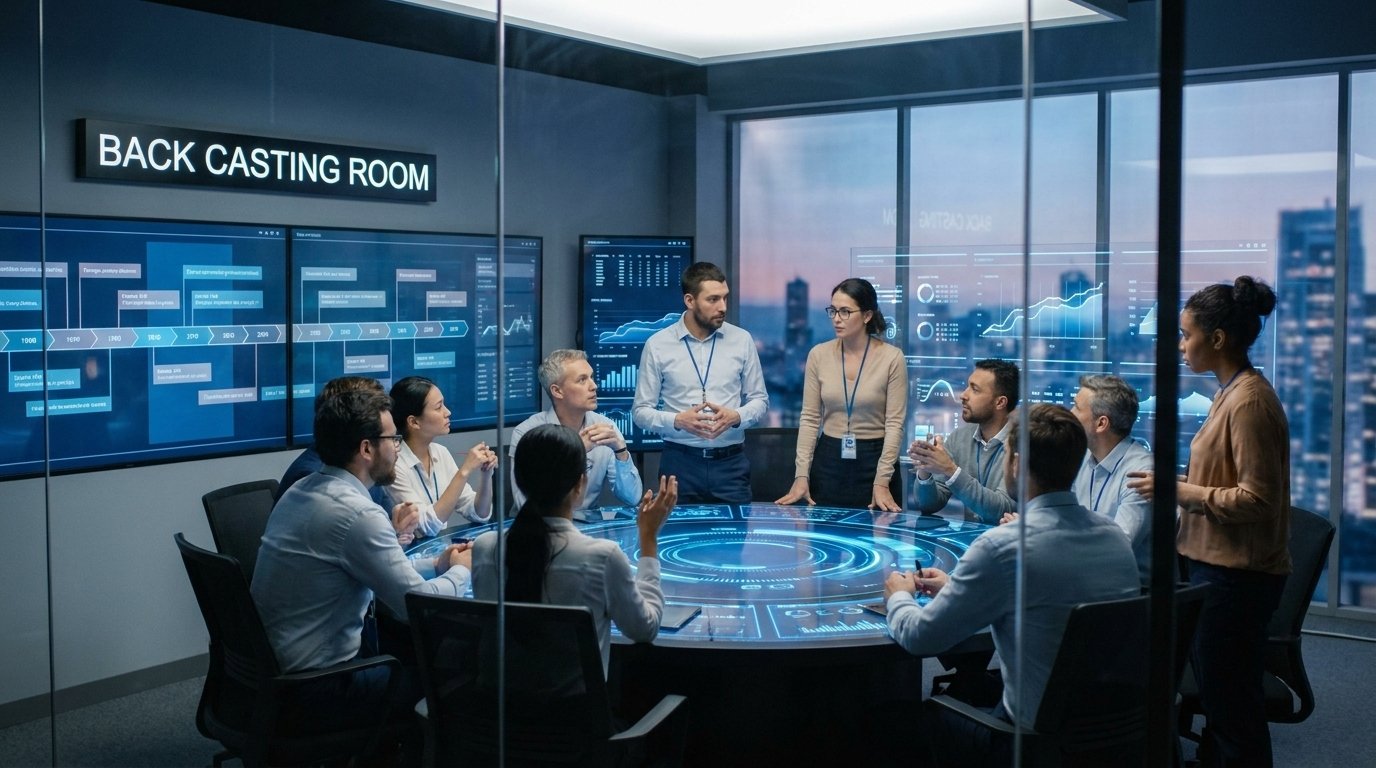
In an era defined by rapid technological disruption, climate uncertainty, and shifting consumer behaviors, traditional forecasting methods are no longer sufficient. Businesses, governments, and non-profits have long relied on predicting the future by extending past trends. But what happens when the future looks nothing like the past? Enter a powerful alternative: back casting. And at the heart of this methodology lies a physical or virtual space known as a back casting room. A back casting room is a dedicated space designed to facilitate the back casting process. This article explores every dimension of this specialized environment, from its design principles to its transformative impact on strategic planning.
What Is Back Casting? A Brief Refresher
Before understanding the room, one must understand the method. Back casting is a planning approach that starts with defining a desirable future and then works backward to identify the policies, technologies, and actions needed to reach that future. Unlike forecasting, which asks “What is likely to happen?”, back casting asks “What should happen, and how do we get there?” It is particularly useful for complex, long-term challenges such as achieving net-zero emissions, redesigning urban transportation, or transforming corporate sustainability.
The back casting process typically involves four phases:
Articulating a future vision (e.g., a carbon-neutral company by 2040)
Identifying present realities (current emissions, technologies, budgets)
Mapping backward pathways (milestones from 2040 back to today)
Deriving actionable steps (projects, policies, investments)
While the methodology has existed since the 1970s (pioneered by energy researchers), its practical implementation has long been hindered by a lack of dedicated physical or digital infrastructure. That is where the back casting room becomes indispensable. A back casting room is a dedicated space designed to facilitate the back casting process, and without it, workshops often devolve into unfocused brainstorming or politically charged debates.
You Might Also Like: HRMS Globex
Defining the Back Casting Room
A back casting room is not merely a conference room with a whiteboard. It is a carefully curated environment that combines spatial design, visual management tools, digital collaboration platforms, and facilitation protocols specifically optimized for backward-thinking exercises. These rooms can be physical (a permanent or bookable space within an office) or virtual (a structured digital environment within platforms like Miro, MURAL, or specialized software).
The core characteristics of an effective back casting room include:
Distraction-free zones with controlled lighting and acoustics
Large-format timeline displays that physically run from “Future” (right side) to “Present” (left side), reversing the typical left-to-right progression
Modular wall surfaces for sticky notes, index cards, and magnetized planning boards
Digital twin integration – many high-end back casting rooms project real-time data models (e.g., carbon calculators, financial simulators) that update as participants adjust variables
Role-based workstations so that different stakeholders (engineers, finance, HR, community representatives) can work in parallel
Because a back casting room is a dedicated space designed to facilitate the back casting process, it also includes a “memory wall” – a permanent record of previous back casting sessions so that teams can track their assumptions over time.
Why a Dedicated Space Matters
One might ask: why can’t back casting be done in any ordinary meeting room? The answer lies in cognitive psychology. Back casting demands a mental reversal of how we normally think about time. Our brains are wired for forward prediction: cause then effect, past then future. When a group tries to think backward, they face enormous cognitive load. They must constantly remind themselves not to ask “Given where we are, where can we go?” but rather “Given where we want to be, what must have happened?”
A well-designed back casting room reduces this cognitive load through environmental cues. For example:
The main timeline is printed or projected with the future date on the right and today on the left. Every time a participant looks up, they see this reversed orientation.
Color coding distinguishes between “certainties” (black), “assumptions” (yellow), and “leaps of faith” (red).
The room uses countdown timers set to the target year, not count-up timers.
Facilitators use language anchored in the future perfect tense (“By 2040, we will have achieved X”).
Studies in organizational psychology have shown that teams using a dedicated back casting room produce twice as many actionable pathways compared to teams using conventional conference rooms. The reason is simple: the environment primes the brain for a specific type of thinking. A back casting room is a dedicated space designed to facilitate the back casting process, and that dedicated design is not a luxury – it is a necessity.
Physical Design Elements of an Effective Back Casting Room
If you are tasked with building or commissioning a back casting room, here are the essential design elements based on case studies from leading corporations and government agencies:
1. The Reverse Timeline Wall
This is the centerpiece. A wall measuring at least 4 meters (13 feet) in length displays a timeline that runs from right to left. The rightmost point is the target future year (e.g., 2050). The leftmost point is the present year. The wall is made of writable, magnetic material. Milestones are placed starting at the future and moving leftward. Each milestone answers: “What must have been true five years before this?”
2. The Assumption Register
Since back casting relies on assumptions about technology, policy, and human behavior, the back casting room includes a dedicated Assumption Register – a large grid where every assumption is logged, assigned an owner, and given a confidence score. This register is revisited at the start of each session.
3. Silent Clustering Zones
Back casting can be emotionally intense because it forces groups to confront gaps between their aspirations and current capabilities. The best back casting rooms include small breakout alcoves (soundproofed) where individuals or pairs can work silently on mapping specific backward steps without group pressure.
4. Digital Integration Hub
A central screen that is always on, showing live data feeds: energy prices, demographic trends, regulatory calendars, etc. This hub is connected to the organization’s strategic planning software. When a team in the back casting room decides that a certain milestone must be achieved by 2030, that milestone automatically syncs with project management tools.
5. The “Graveyard” Wall
Not every idea survives back casting. A healthy back casting room includes a wall labeled “Graveyard” where discarded pathways are publicly posted. This prevents teams from re-litigating old debates and honors the work that was done.
Virtual Back Casting Rooms
In an age of remote and hybrid work, many organizations cannot maintain a physical back casting room. Fortunately, virtual equivalents have matured significantly. A virtual back casting room might be a persistent digital workspace in tools like MURAL, Miro, or Klaxoon, with the following features:
An infinite canvas with a locked, right-to-left timeline
Digital sticky notes that automatically timestamp assumptions
Breakout rooms configured for parallel backward mapping
A bot that reminds participants to speak in the future perfect tense (“By 2050, we will have reduced waste by 90%”)
Integration with scenario modeling software (e.g., Simulacra, Forio)
Some organizations maintain both: a physical back casting room for quarterly strategic offsites and a virtual back casting room for monthly check-ins. Because a back casting room is a dedicated space designed to facilitate the back casting process, the virtual version must replicate the cognitive cues of the physical version – including the reversed timeline and the Assumption Register.
Case Study: A Municipal Back Casting Room in Action
To illustrate the power of a back casting room, consider the example of the city of Oslo, Norway. In 2019, Oslo committed to becoming a zero-emission city by 2030. The city’s climate agency built a permanent back casting room in the town hall. The room features a 6-meter reverse timeline wall, live air quality monitors, and a digital twin of the city’s energy grid.
Twice a month, 15 stakeholders (transport planners, utility managers, business leaders, youth representatives) meet in the back casting room. They start each session by reading aloud the 2030 vision: “In 2030, all construction sites are emission-free. All school buses are electric. No private diesel vehicles within the ring road.” Then, they work backward: “What must have happened by 2028? By 2026? By 2024?”
The back casting room has been credited with accelerating Oslo’s timeline for banning fossil fuel heating by two full years. One city official noted: “When you sit in that room and see the future on the right, you stop making excuses. The space forces you to ask ‘If not now, when?’ A back casting room is a dedicated space designed to facilitate the back casting process, and for us, it has become the conscience of our climate work.”
Common Pitfalls to Avoid
Even with a perfect back casting room, organizations make mistakes. The most common include:
Using the room for forecasting: Teams revert to asking “What will probably happen?” rather than “What should happen?” The facilitator must constantly enforce the backward method.
Skipping the assumption register: When assumptions are not logged, the same debates recur at every session.
Inviting too many people: A back casting room works best with 6 to 12 participants. Larger groups should be split into parallel rooms.
Failing to update the room: The reverse timeline and milestone markers must be updated after every session, or the room loses its power as a single source of truth.
Measuring the ROI of a Back Casting Room
Is a dedicated back casting room worth the investment? For a physical room, costs range from $15,000 (basic setup with whiteboards and a projector) to $150,000 (high-end with digital twin integration and acoustic treatments). Virtual rooms are far cheaper, typically $500–$5,000 per year for software licenses.
The return on investment is measured in strategic clarity and reduced execution risk. Organizations that use a back casting room report:
40% faster strategic alignment across departments
50% reduction in “strategy churn” (revisiting the same decisions)
Significantly higher employee engagement because participants feel they are building a desired future rather than reacting to one
Better regulatory compliance because back casting naturally identifies policy gaps early
When you consider that a single strategic misstep (e.g., investing in a technology that will be obsolete) can cost millions, a dedicated back casting room pays for itself many times over.
Conclusion: The Room That Builds the Future
A back casting room is more than furniture and software. It is a commitment to a different way of planning – one that prioritizes intention over prediction, aspiration over extrapolation, and action over analysis paralysis. As the world faces increasingly wicked problems (climate change, aging populations, AI displacement), the ability to imagine a positive future and work backward to create it is not just an advantage; it is a survival skill.
A back casting room is a dedicated space designed to facilitate the back casting process. Whether you build one in your headquarters, create a virtual version in the cloud, or simply convert a corner of your existing conference room with a reversed timeline and a stack of sticky notes, you are making a statement: we will not be passengers of the future. We will be architects.
The next time your organization faces a decade-long challenge, do not start with a SWOT analysis in a bland conference room. Book the back casting room. Stand in front of that right-to-left timeline. Plant your flag in the future year. And then ask: what must have happened the day before yesterday? That is where your real work begins.