
 By Callum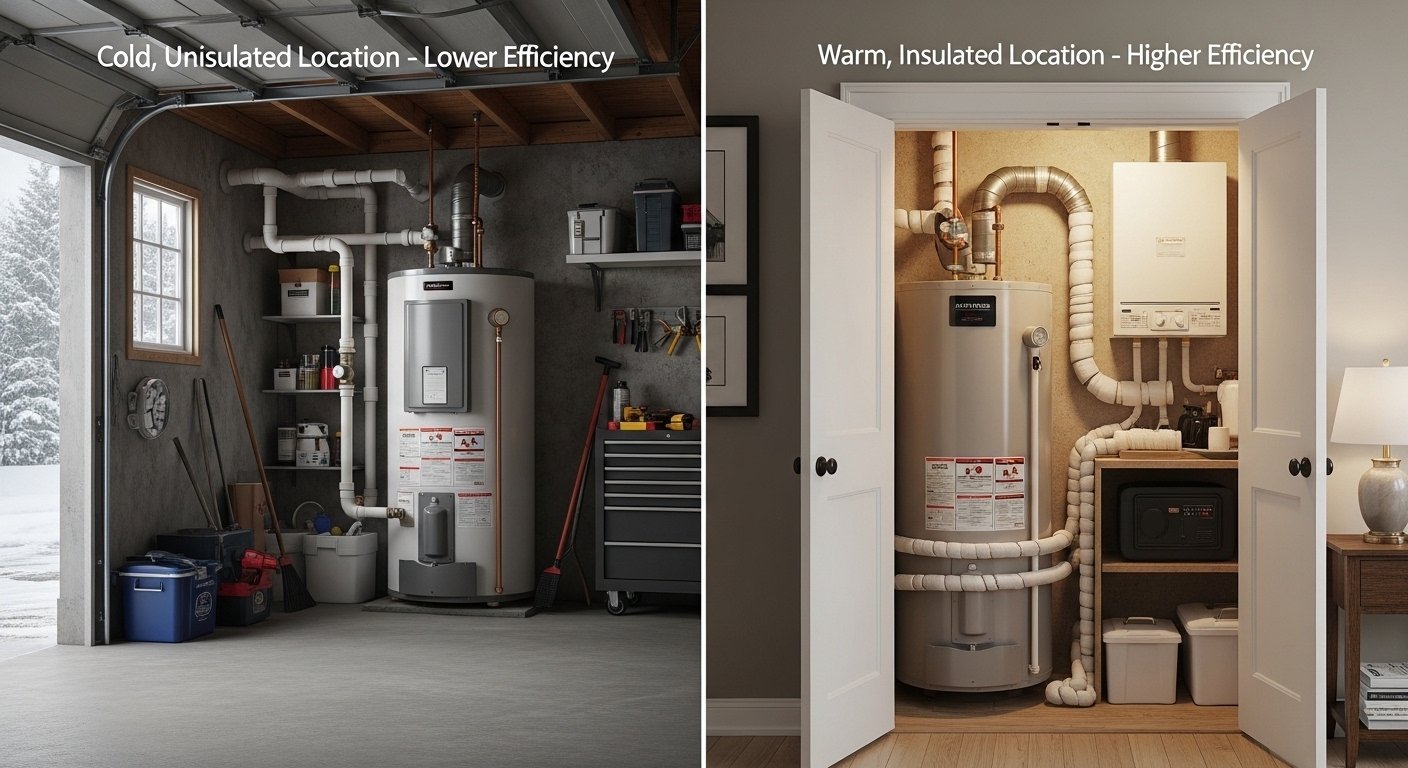
Where a water heater is installed affects more than convenience, because its location determines how much heat is lost before hot water reaches a faucet and how hard the unit must work to maintain the desired temperature. A heater placed far from bathrooms and kitchens pushes more hot water through long pipe runs, increasing standby losses and wasting water while occupants wait for heat to arrive. The surrounding environment matters too. A unit in a cold garage or unconditioned basement loses heat faster than one in a temperate utility room, and some heater types interact with the space in ways that raise or lower overall efficiency. Location also influences venting, maintenance access, and safety provisions, all of which can affect long-term performance. Understanding these location factors helps homeowners choose placements that reduce energy use while improving comfort and reliability.
Location factors that change performance
Distance to fixtures and the hidden cost of long piping
The biggest efficiency impact often comes from distance and piping layout. When the heater is far from high-use fixtures, more hot water remains in the line and cools between uses, increasing the reheating required and the time spent waiting for warm water. Each time a faucet is opened, the first portion is often cooled water that must be flushed out, wasting both water and the energy previously used to heat it. Long trunk lines and multiple branches increase surface area for heat to escape, especially when pipes run through unconditioned spaces or are not insulated.
Layout issues can also create recirculation problems, where hot water loops incorrectly or never reaches distant points efficiently. Placing the heater closer to the most frequently used fixtures shortens the hot-water path and reduces the volume of cooled water that must be drained with each draw. In many homes, a single central location can still be inefficient if bathrooms are at opposite ends, which is why some properties benefit from point-of-use solutions or zoning strategies. The key idea is that hot water loses value as it travels, and a longer path almost always increases losses.
Ambient temperature and how the surrounding space steals heat
The room or area around the heater affects standby heat loss, which is the energy required to keep stored water at a set temperature when no one is using it. A heater installed in a cold garage, drafty basement, or vented crawlspace experiences a greater temperature difference between the tank and the air, so heat moves out of the tank faster through the tank jacket and connected piping. That means more frequent burner cycles or electric element operation to maintain the same setpoint.
Some homeowners notice this as a heater that seems to run often, even when water use is low, especially during winter. In conditioned spaces, heat that escapes the tank may partially remain inside the home, reducing perceived loss in colder months but still being undesirable in warm seasons because it adds indoor heat load. Heat pump water heaters are especially sensitive to location because they pull heat from the surrounding air. If placed in a cold space, they may struggle and rely more on resistance backup. Crofton Water Heater Installation planning often considers whether the unit is in a space with a stable air temperature and enough volume for efficient operation without excessive cooling of the room. Location, therefore, becomes part of the heater’s operating environment, not just a storage spot.
Venting, combustion air, and efficiency stability
For gas water heaters, location affects the venting configuration and combustion air availability, which in turn affect how steadily the unit burns and how safely it operates. Longer vent runs, too many elbows, or poor vent sizing can reduce draft and lead to inefficient combustion or nuisance shutdowns. An interior location may allow shorter, straighter venting, while a distant or cramped corner can require more complex routing, increasing resistance.
Combustion air supply is also important. A heater placed in a tight closet without sufficient air can struggle to burn cleanly, while a heater in a large space may have more stable combustion air but could still face drafting issues if nearby exhaust fans depressurize the area. For direct-vent and power-vent units, location affects fan noise, condensate routing, and how easily the vent terminates outdoors. A well-chosen location provides a reliable draft and reduces the risk of backdrafting or performance drift. That stability matters because incomplete combustion and repeated cycling can waste fuel and increase wear. Efficiency is not just a rating; it depends on the heater operating under conditions that support consistent venting and air supply.
Placement shapes energy and comfort.
The location of the water heater affects heating efficiency by changing how far the hot water must travel, how much heat is lost in the piping, and how quickly stored water cools in the surrounding space. Cold or drafty locations increase standby losses, while poor venting routes and limited combustion air can reduce stable operation for gas units. Accessibility matters because difficult locations discourage maintenance, allowing sediment, airflow restrictions, and unnoticed leaks to erode performance over time. When distance is unavoidable, design choices such as pipe insulation, controlled recirculation, or point-of-use support can reduce heat and water waste. A well-chosen location balances proximity to high-use fixtures, suitable ambient conditions, safe venting, and easy service access, leading to steadier efficiency and more consistent hot water delivery.