
 By Callum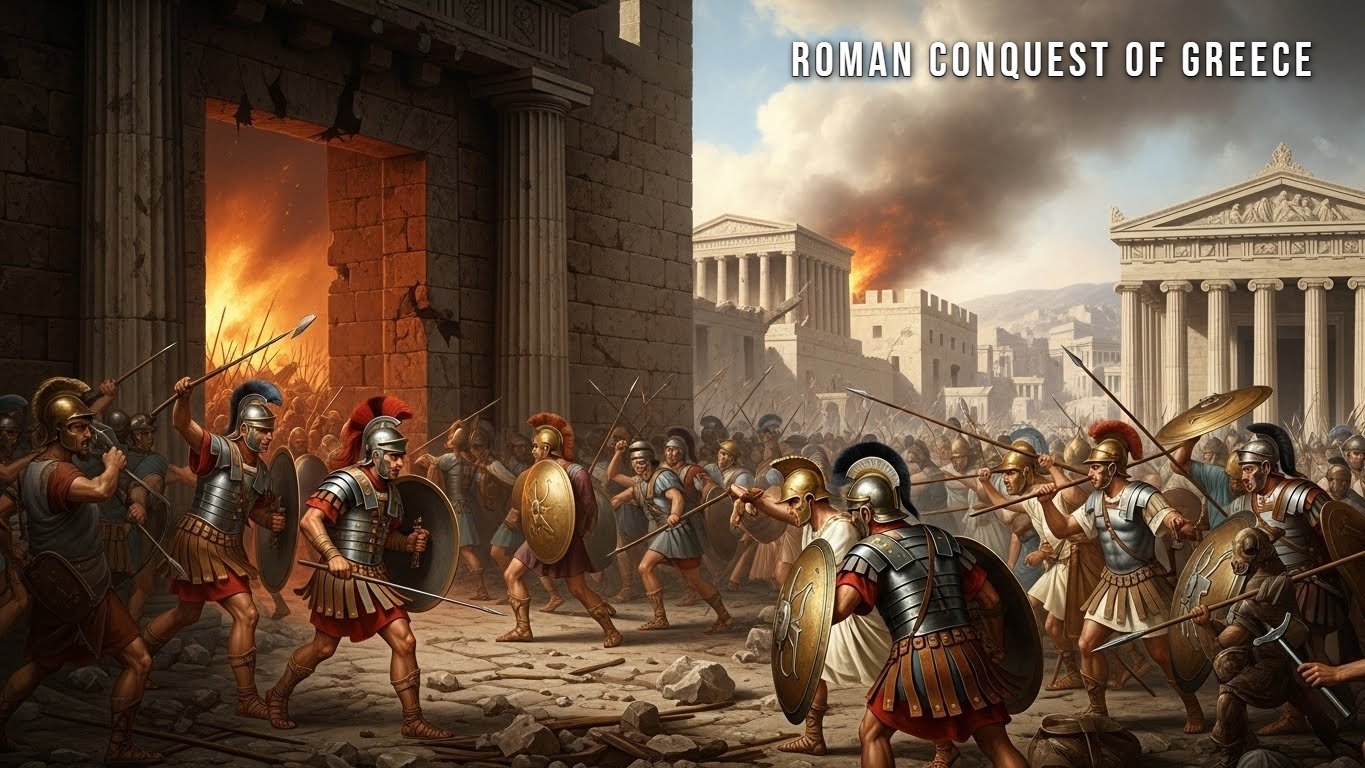
The roman conquest of greece was not a single dramatic event but a long and complex process that unfolded over more than a century. It marked a turning point in Mediterranean history, ending Greek political independence while simultaneously allowing Greek culture to profoundly influence Roman civilization. Although Rome emerged as the dominant military and political power, Greece remained a vital intellectual and cultural force within the Roman world. Understanding this conquest requires examining the political fragmentation of Greece, Rome’s expansionist ambitions, and the wars that gradually brought the Greek mainland under Roman control.
Greece Before Roman Intervention
By the third century BCE, Greece was no longer unified under a single power. The glory days of classical Athens and Sparta had passed, and the region was divided among rival city-states and Hellenistic kingdoms. Macedonia, under Philip II and Alexander the Great, had previously dominated Greece, but after Alexander’s death, his empire fragmented.
Greek leagues such as the Achaean League and the Aetolian League attempted to preserve autonomy through collective security. However, constant infighting weakened their ability to resist external threats. This political disunity played a major role in enabling the roman conquest of greece, as Rome often exploited rivalries between Greek states to extend its influence.
Rome’s Rise as a Mediterranean Power
Rome’s involvement in Greek affairs began indirectly. During the third century BCE, Rome was focused on Italy and the western Mediterranean, particularly during the Punic Wars against Carthage. Victory over Carthage transformed Rome into a major power with interests extending eastward.
You Might Also Like: The History of Pantagonar
As Rome’s influence grew, it became increasingly entangled in the politics of the eastern Mediterranean. Greek states sometimes invited Roman intervention to counter Macedonian aggression, unaware that Rome’s assistance would eventually lead to domination. This strategic miscalculation set the stage for the roman conquest of greece.
The Macedonian Wars
The Macedonian Wars were central to Rome’s expansion into Greece. These conflicts, fought between Rome and the Kingdom of Macedon, spanned much of the 3rd and 2nd centuries BCE.
First Macedonian War (214–205 BCE)
The First Macedonian War occurred while Rome was engaged in the Second Punic War. King Philip V of Macedon allied with Hannibal, prompting Rome to intervene in Greek affairs. Although the war ended inconclusively, it marked Rome’s first major military involvement in the Greek world.
Second Macedonian War (200–197 BCE)
The Second Macedonian War proved decisive. Roman forces defeated Philip V at the Battle of Cynoscephalae in 197 BCE. This battle demonstrated the superiority of the Roman legion over the Macedonian phalanx. Following the victory, Rome declared the “freedom of the Greeks,” a proclamation that was popular but ultimately misleading, as Roman influence continued to grow.
Roman Diplomacy and Greek Leagues
After defeating Macedon, Rome did not immediately annex Greece. Instead, it pursued a strategy of indirect control through diplomacy and alliances. Greek leagues were encouraged to maintain autonomy, but only as long as their actions aligned with Roman interests.
The Aetolian League soon grew resentful of Roman dominance and accused Rome of replacing Macedonian tyranny with its own. These tensions contributed to renewed conflicts and further weakened Greek resistance. Rome’s ability to present itself as a liberator while steadily expanding its authority was a defining feature of the roman conquest of greece.
The Third Macedonian War and the Fall of Macedon
The Third Macedonian War (171–168 BCE) was the final confrontation between Rome and Macedon. King Perseus attempted to restore Macedonian power but lacked the resources and alliances needed to challenge Rome effectively.
The decisive moment came at the Battle of Pydna in 168 BCE, where Roman forces again crushed the Macedonian army. Macedon was dismantled and divided into smaller republics under Roman supervision. This victory removed the last major power capable of resisting Rome in Greece.
Destruction of Corinth
One of the most symbolic events in the roman conquest of greece was the destruction of Corinth in 146 BCE. The city, a leading member of the Achaean League, rebelled against Roman authority. Rome responded with overwhelming force.
Corinth was sacked, its population killed or enslaved, and its wealth carried off to Rome. The destruction sent a clear message to the Greek world: resistance to Rome would not be tolerated. In the same year, Rome also destroyed Carthage, confirming its dominance across the Mediterranean.
Greece as a Roman Province
Following the fall of Corinth, Greece effectively came under Roman control. While some cities retained a degree of local autonomy, true independence was gone. By 27 BCE, under Emperor Augustus, Greece was formally organized as the province of Achaea.
Roman administration focused on maintaining order and collecting taxes rather than imposing cultural change. Local elites often cooperated with Roman authorities, benefiting from stability and access to the wider Roman economy. This pragmatic approach helped Rome secure long-term control after the roman conquest of greece.
Cultural Impact on Rome
Ironically, while Rome conquered Greece militarily, Greek culture conquered Rome intellectually. Roman elites admired Greek philosophy, art, literature, and education. Wealthy Romans sent their children to study under Greek tutors, and Greek became a language of culture and learning.
Greek architects, artists, and scholars migrated to Rome, transforming Roman society. Temples, statues, and public buildings reflected Greek styles, while Stoicism and other Greek philosophies shaped Roman thought. The roman conquest of greece thus resulted in a cultural exchange rather than simple domination.
Economic and Social Changes in Greece
Roman rule brought both challenges and opportunities to Greece. On one hand, heavy taxation and land confiscations harmed small farmers and local economies. Many Greeks were enslaved or displaced during the wars.
On the other hand, incorporation into the Roman Empire created new trade networks and economic stability. Cities that adapted to Roman rule, such as Athens, continued to thrive as centers of learning and culture. Over time, Greece found a new role within the Roman world.
Resistance and Adaptation
Despite military defeat, Greek identity endured. Local traditions, religious practices, and civic institutions survived under Roman oversight. Occasional revolts occurred, but none seriously threatened Roman control.
Greek intellectual life flourished during the Roman period, producing influential figures in philosophy, history, and science. This resilience highlights that the roman conquest of greece was not the end of Greek civilization but rather a transformation of its political context.
Long-Term Historical Significance
The long-term consequences of Roman rule in Greece were profound. The fusion of Greek and Roman traditions laid the foundation for Greco-Roman culture, which would shape Western civilization for centuries. Law, philosophy, art, and governance all benefited from this synthesis.
The conquest also demonstrated Rome’s transition from a regional power to a true empire. Lessons learned in Greece influenced Roman governance elsewhere, particularly in balancing military authority with local autonomy.
Conclusion
The roman conquest of greece was a gradual and multifaceted process driven by Greek disunity and Roman ambition. While Rome emerged victorious on the battlefield, it became deeply influenced by the culture of the people it conquered. Greece lost political independence but gained a lasting legacy through its impact on Roman civilization. Rather than marking an abrupt end, the conquest represents a pivotal moment of cultural integration that reshaped the ancient Mediterranean world.