
 By Callum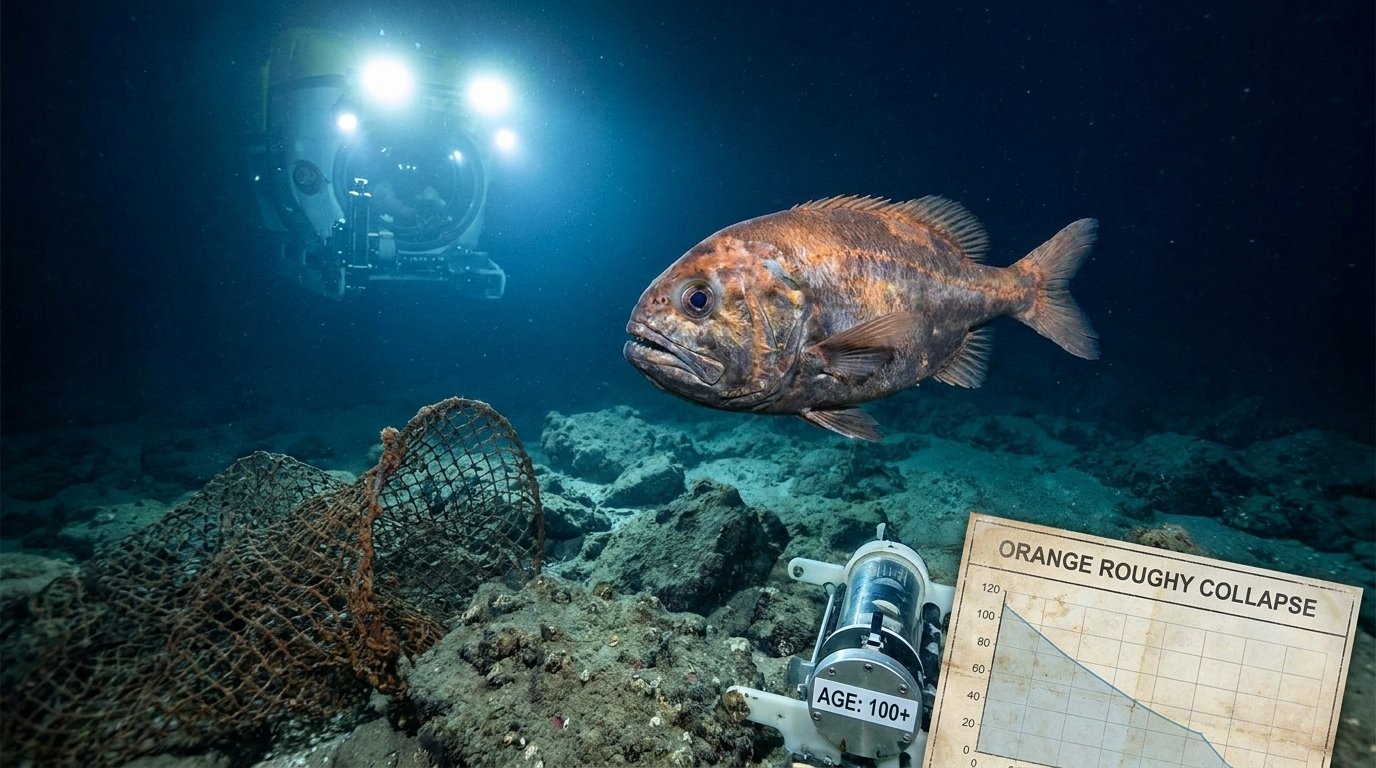
The orange roughy (Hoplostethus atlanticus), also known as the red roughy, slimehead and deep sea perch, is a relatively large deep-sea fish that has become a modern symbol of both the ocean’s mysteries and humanity’s capacity for overexploitation. At first glance, it is an unremarkable creature—a slow-moving, reddish-orange fish with a bony head and a slime-producing channel system (hence the name “slimehead”). Yet beneath its modest exterior lies one of the most extreme life histories in the vertebrate world. The story of the orange roughy is a paradoxical tale: a fish built for centuries of survival, yet brought to the brink of commercial extinction in just a few decades.
Physical Description and Unique Adaptations
The orange roughy is a distinctive-looking fish. It typically measures between 30 and 40 centimeters in length, though some individuals can reach nearly 75 centimeters and weigh up to 7 kilograms. Its body is deep and compressed laterally, covered in small, rough, ctenoid scales that give it a texturized feel. The name “roughy” derives from this texture. As the common name suggests, its coloration is a vivid, fiery orange-red, which fades to a paler yellow or white on the belly. Interestingly, this color may serve as camouflage in the deep ocean. Where red wavelengths of light are the first to be absorbed; at depths of 500 to 1,800 meters. The orange roughy appears virtually black, invisible to predators and prey alike.
One of its most notable anatomical features is the system of mucus-filled canals on its head, which gives rise to the alternative name “slimehead.” These canals are part of a sophisticated lateral line system, allowing the fish to detect minute water vibrations and movements in the pitch-black environment. The orange roughy also possesses large, tubular eyes adapted to low light, enabling it to spot the bioluminescent flashes of small squid and fish. Its mouth is large and lined with fine teeth, designed for an opportunistic diet of crustaceans, lanternfish, and cephalopods.
You Might Also Like: Broghammerus Reticulatus Facts
A Life in Slow Motion: The Oldest Pelagic Fish
If there is one fact that defines the orange roughy, it is extreme longevity. For decades, scientists were unaware of just how old these fish could become. Early estimates suggested a lifespan of 20–30 years, but otolith (ear bone) analysis—much like counting tree rings—revealed a shocking truth. The orange roughy is one of the longest-living marine fish species on Earth, with documented ages exceeding 150 years, and some unconfirmed reports suggesting individuals may live past 200 years. The oldest verified specimen was 149 years old. This means that many orange roughy caught in the 1970s and 1980s were born before the American Civil War.
Such longevity is made possible by a suite of slow-life-history traits. The orange roughy grows at a glacial pace, does not reach sexual maturity until at least 20 to 30 years of age, and some populations may not begin reproducing until 40 years old. Their metabolism is exceptionally low, an adaptation to the frigid, food-scarce depths of the bathyal zone (500–1,500 meters). They exist in a state of biological slow motion: feeding rarely, moving little, and expending minimal energy. This strategy is ideal for survival in a stable, resource-poor environment, but it is catastrophic when confronted with industrial fishing.
Reproductive Strategy: A Bottleneck in the Dark
The reproductive biology of the orange roughy is as extreme as its lifespan. They are not broadcast spawners like many pelagic fish; instead, they gather in dense aggregations—often on undersea hills, ridges, and seamounts—to spawn once per year. Typically between June and August in the Southern Hemisphere. Females produce a relatively small number of large, buoyant eggs (tens of thousands rather than millions), which float to shallower depths before hatching. Larvae and juveniles remain in surface waters for several years before descending to the depths.
Because they aggregate so predictably in specific locations, the orange roughy is exceptionally vulnerable to bottom trawling. A single trawler can scoop up an entire spawning aggregation in minutes—an aggregation that may have taken half a century to form. Furthermore, the fish do not spawn every year in all populations; some may skip spawning seasons depending on food availability. This erratic, slow reproduction means that even light fishing pressure can cause population collapse.
Historical Discovery and the Boom-Bust Fishery
The orange roughy was largely unknown to science before the 1970s. It was first described in 1889 from specimens collected off the coast of New Zealand, but it was considered a rare, deep-sea oddity. That changed abruptly in the late 1970s when commercial fishers, exploring deep-sea seamounts for new resources, discovered massive aggregations of orange roughy off the coasts of New Zealand, Australia, Namibia, and the Northeast Atlantic. The fish was rebranded from “slimehead” (a decidedly unappetizing name) to “orange roughy”—a marketing masterstroke. Its firm, white, mildly flavored fillets became a sensation in seafood markets, particularly in the United States. Where it was often compared to tilapia or snapper.
What followed was a classic boom-bust cycle. From 1979 to the early 1990s, an international fleet of deep-sea trawlers vacuumed up orange roughy from seamounts with reckless efficiency. Catches peaked in 1989–1990 at nearly 90,000 metric tons globally. But within a decade, stocks had cratered. By the late 1990s, landings had dropped by more than 70%. The original New Zealand stock, once estimated at over 100,000 tons, was reduced to less than 15% of its unfished biomass. Australian stocks off the coast of Tasmania collapsed from an estimated 80,000 tons to just 5,000 tons. The orange roughy became the poster child for unsustainable deep-sea fishing.
Ecological Consequences of Overfishing
The crash of orange roughy populations did not occur in isolation. Deep-sea trawling for orange roughy also devastates benthic habitats. The weighted nets and steel rollers used to catch these fish scrape across seamounts, destroying centuries-old cold-water coral gardens, glass sponges, and other structure-forming organisms that provide shelter for countless deep-sea species. Because these habitats grow at rates of millimeters per year, recovery may take centuries—if it happens at all.
Moreover, the removal of orange roughy as a top predator in deep-sea food webs has unknown cascading effects. Their main prey—squid, lanternfish, and crustaceans—may explode in number, altering the carbon cycle and nutrient flow in the deep ocean. Conversely, bycatch species caught alongside orange roughy, including deep-sea sharks, rattails, and oreos, themselves slow-growing and long-lived, have also suffered steep declines.
Current Status and Management
Today, the orange roughy is classified as “Conservation Dependent” in some regions by the IUCN, but globally, it is considered vulnerable to extinction. In New Zealand and Australia, the two largest historic fisheries, strict quotas, seasonal closures. Marine protected areas (including the Tasmanian Seamounts Marine Reserve) have been implemented. A fishery improvement project (FIP) for orange roughy in New Zealand has allowed some stocks to show signs of slow recovery. The New Zealand quota management system, introduced in the late 1990s. Reduced catches from over 50,000 tons annually to less than 3,000 tons in recent years. Some scientists suggest that certain populations, such as those on the Chatham Rise, are increasing at 1–2% per year. At this rate, full recovery to pre-fishing levels would take 70–100 years.
However, the orange roughy remains highly vulnerable to illegal, unreported, and unregulated (IUU) fishing on the high seas, particularly in the South Pacific and Southern Indian Ocean. Seamount chains outside national jurisdiction are often targeted by pirate trawlers that ignore catch limits. The South Pacific Regional Fisheries Management Organisation (SPRFMO) has attempted to regulate these areas, but enforcement is challenging.
Consumer Choices and the Future
For consumers, the message is mixed but cautionary. Several seafood guides, including the Marine Stewardship Council (MSC), have certified certain orange roughy fisheries (e.g., the New Zealand eastern stock) as sustainable. However, environmental groups like the Monterey Bay Aquarium’s Seafood Watch program continue to list most orange roughy as “Avoid,” citing concerns over stock uncertainty, bycatch, and habitat damage. A 2023 assessment by the Deep Sea Conservation Coalition argued that no orange roughy fishery can be truly sustainable given the fish’s extreme life history and the destructive nature of bottom trawling.
If you see orange roughy on a menu or at a fish counter, it is worth asking where it came from. Even certified fisheries rely on decades-old stock models that may underestimate true depletion. Given that a female orange roughy does not reproduce until she is at least 25 years old—and may live to 150—fishing any significant fraction of the adult population is biologically risky.
Conclusion: An Ancient Fish in a Modern World
The orange roughy (Hoplostethus atlanticus), also known as the red roughy, slimehead and deep sea perch, is a relatively large deep-sea fish, but its size is the least remarkable thing about it. This ancient animal has witnessed centuries of ocean history, quietly growing on seamounts long before humans ventured into the abyss. In a single generation, we have undone what took millennia to build.
The orange roughy is not yet extinct, but its story serves as a stark reminder: in the deep sea, time moves differently. A fishery can collapse in a decade, but a single fish may take a century to replace. Whether the orange roughy will recover—or simply fade into legend as the fish that was too old to outrun us—depends entirely on the collective restraint of fishing nations and informed choices by consumers. For now, the orange roughy swims on, a ghost of the deep, carrying its 200-year-old secrets through a world that nearly forgot it existed.